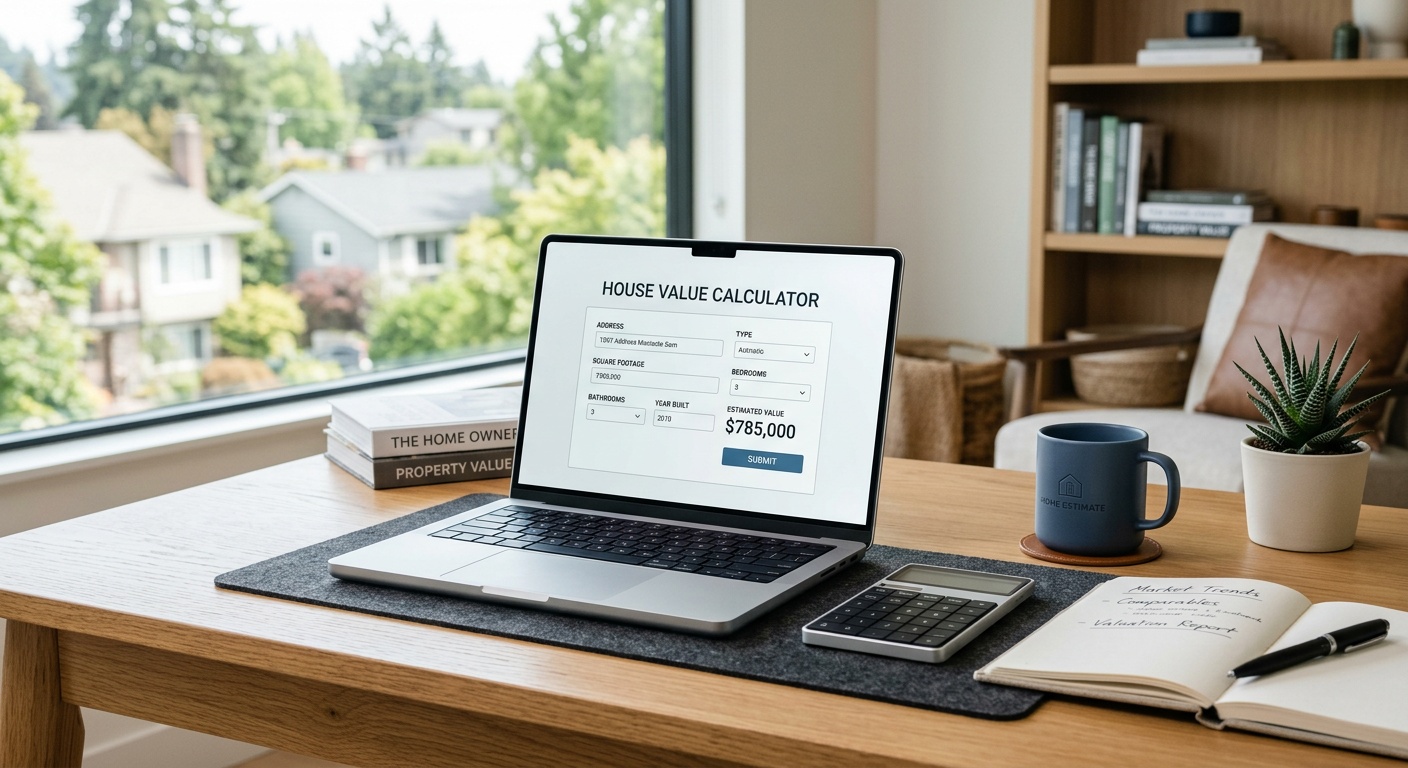
How to Use Online Home Value Calculators for NoCo Properties
Reading time: 12 minutes
You’ve just spotted a charming craftsman bungalow in Fort Collins, or maybe you’re eyeing a sprawling ranch-style home on the outskirts of Loveland. Before you make any move — whether you’re buying, selling, or refinancing — you need one critical piece of information: What is this property actually worth?
Northern Colorado (NoCo) has been one of the most dynamic real estate markets in the Mountain West region, and 2026 hasn’t slowed things down. With median home prices in Fort Collins hovering around $565,000 and Greeley continuing its steady climb into the $390,000 range, getting an accurate home valuation isn’t just helpful — it’s financially essential.
Online home value calculators have become the go-to starting point for millions of homeowners, buyers, and investors. But here’s the straight talk: not all calculators are created equal, and NoCo’s unique market quirks can cause even the best algorithms to miss the mark. This guide will show you exactly how to use these tools intelligently, what their limitations are, and how to cross-reference results for the most accurate NoCo property estimate possible.
Table of Contents
- Why NoCo’s Real Estate Market Demands Special Attention
- How Online Home Value Calculators Actually Work
- The Top Tools for NoCo Property Valuation in 2026
- Step-by-Step: Using Calculators Effectively for NoCo Homes
- Common Pitfalls and Limitations to Watch For
- NoCo Market Value Accuracy by Tool (Data Visualization)
- Comparative Table: Top Home Value Calculators
- Real-World NoCo Examples
- Frequently Asked Questions
- Your NoCo Valuation Action Plan
Why NoCo’s Real Estate Market Demands Special Attention
Northern Colorado isn’t just a geographic designation — it’s a collection of distinct micro-markets that behave very differently from one another. Fort Collins, Loveland, Greeley, Windsor, Berthoud, and Longmont each carry their own pricing dynamics, buyer demographics, and appreciation trends. What makes NoCo particularly challenging for automated valuation models (AVMs) is the dramatic variation in property types across short distances.
Consider this: a 2,200-square-foot home in the Fossil Creek neighborhood of Fort Collins might be valued $80,000 higher than a nearly identical home in east Greeley — not because of square footage, but because of school districts, proximity to Colorado State University employment corridors, and municipal water access. Generic national calculators rarely capture these granular differences.
NoCo Market Snapshot in 2026
The NoCo real estate market has experienced several defining shifts entering 2026:
- Interest rate stabilization: After the turbulent rate environment of 2023–2024, 30-year fixed mortgage rates settled into the 6.2%–6.8% range by mid-2025, bringing more predictability to buyer purchasing power.
- Inventory normalization: Active listings in Larimer County increased approximately 18% year-over-year by Q1 2026, reducing the extreme seller’s market conditions of prior years.
- Remote worker migration: NoCo continues attracting remote workers from Denver, Boulder, and California seeking more affordable options with outdoor lifestyle access.
- New construction pressure: Windsor and Berthoud saw significant new development in 2025, creating pockets where resale homes compete directly with builder incentives.
These dynamics mean your home’s value is a moving target — and understanding how to use calculators within this context is the difference between making smart decisions and costly assumptions.
How Online Home Value Calculators Actually Work
Before you trust a number generated by an algorithm, you should understand what’s happening behind the scenes. Online home value calculators — often called Automated Valuation Models or AVMs — use statistical algorithms to estimate a property’s market value based on publicly available data.
The Data Sources Behind the Numbers
Most reputable AVM tools pull from several key data streams:
- Public record data: County assessor records, tax rolls, and deed transfers provide baseline property characteristics like square footage, lot size, number of bedrooms/bathrooms, and year built.
- MLS transaction data: Recent sales of comparable properties (comps) within a defined radius form the backbone of most valuations.
- Listing data: Active listings and days-on-market information help AVMs understand current demand and pricing trends.
- User-submitted data: Some platforms allow homeowners to update property details — like a recently remodeled kitchen — which can significantly influence the estimate.
- Neighborhood trend data: Macro-level appreciation rates, school ratings, walkability scores, and local economic indicators are layered in by more sophisticated models.
The challenge for NoCo properties specifically is that Larimer and Weld County assessor data can lag significantly behind market conditions. Colorado’s property tax assessment cycle means some records reflect values from 18–24 months prior, which in a fluctuating market, creates meaningful discrepancies.
As real estate technology analyst Dr. Patricia Nguyen of the Urban Land Institute noted in her 2025 report on Mountain West AVMs: “AVM accuracy in secondary metros like Fort Collins improves substantially when local listing volume exceeds 200 transactions per month — a threshold NoCo markets don’t consistently maintain outside peak spring selling seasons.”
The Top Tools for NoCo Property Valuation in 2026
Not all calculators perform equally when applied to NoCo properties. Here are the most relevant platforms and their specific strengths for this market:
Zillow’s Zestimate
Zillow remains the most widely recognized AVM in the country. The Zestimate uses a neural network model that, as of 2025 updates, incorporates listing photos and listing description text through computer vision analysis. For Fort Collins specifically, Zillow’s median error rate has improved to approximately 3.2% for on-market properties, though off-market estimates can swing to 6–9% in less-active Weld County neighborhoods.
Redfin Estimate
Redfin’s model is notably strong in markets where Redfin agents are actively transacting. Given Redfin’s solid presence in the Front Range, their estimates for Fort Collins and Loveland tend to be competitive. Redfin claims a median error of 2.08% for listed properties nationally — a figure that Colorado users generally validate in active market conditions.
Realtor.com Home Value Estimator
Powered by CoreLogic data, Realtor.com’s tool integrates deep public record databases and provides a confidence score alongside its estimate — a feature particularly useful for NoCo buyers trying to gauge how reliable the output is.
Chase MyHome and Bank-Based Estimators
For refinancing purposes, bank-sponsored AVMs like Chase MyHome aggregate multiple AVM sources and present a range rather than a single figure. This approach is more honest about uncertainty and works reasonably well for Windsor and Loveland properties where comparable sales are moderately abundant.
Colorado-Specific Tools: REcolorado and IRES
The REcolorado and IRES (Information Real Estate Services) MLS platforms serve Colorado’s Front Range and NoCo markets respectively. While not public-facing in the same way as Zillow, many local agent tools and county assessor websites tap directly into IRES data. If you’re working with a NoCo real estate agent, ask them to pull a Comparative Market Analysis (CMA) using IRES — this will likely be the most locally accurate data available to you.
Step-by-Step: Using Calculators Effectively for NoCo Homes
Ready to get practical? Here’s a structured process for using home value calculators to get the most reliable NoCo estimate possible.
Step 1: Run Multiple Calculators Simultaneously
Never rely on a single tool. Run estimates on Zillow, Redfin, and Realtor.com at minimum. Record each estimate and note the confidence intervals or ranges provided. For a NoCo property, you might see variance of $20,000–$50,000 across tools — this range itself is data.
Step 2: Verify the Property Details Are Accurate
Log in or create an account on each platform and check the property details being used. Common errors in NoCo properties include: incorrect square footage (especially for homes with finished basements counted differently), missing bathroom counts, and outdated bedroom configurations after room additions.
Step 3: Update With Recent Improvements
If you’ve renovated a kitchen, added a bathroom, replaced the roof, or finished a basement since the last county assessment, update this information on platforms that allow it. A finished basement in Fort Collins adds measurable value that an AVM may not capture without this input.
Step 4: Analyze the Comparable Sales Being Used
Most calculators allow you to see which comparable sales (comps) influenced the estimate. Review these carefully. Are they truly comparable? A comp from a new construction home in a Windsor development shouldn’t be heavily weighted against a 1990s-era resale in Loveland. Flag mismatched comps and look for patterns.
Step 5: Cross-Reference With the Larimer or Weld County Assessor
Visit the Larimer County Assessor’s website or Weld County Assessor’s property search tool to pull the most recent assessed value. While assessed value typically runs 10–20% below market value in Colorado, the gap can tell you something about appreciation trends.
Step 6: Layer in Local Market Intelligence
Check the Fort Collins Board of Realtors monthly market reports, available free online. These reports provide median days on market, list-to-sale price ratios, and inventory levels by zip code — context that no AVM fully incorporates but that significantly affects your pricing strategy.
Common Pitfalls and Limitations to Watch For
Here’s where many NoCo homeowners and buyers get tripped up. Online calculators are powerful starting tools, but they have meaningful blind spots in this specific market.
Pitfall 1: Over-Relying on a Single “Zestimate”
It bears repeating because it’s the most common mistake: treating any single AVM output as a definitive appraisal value. In fast-moving NoCo neighborhoods like Old Town Fort Collins or the SouthRidge area of Loveland, the market can shift 2–4% within a single quarter. A calculator updated monthly can’t keep pace.
Pitfall 2: Ignoring Hyper-Local Factors
Northern Colorado has deeply localized value drivers that algorithms struggle to quantify. Proximity to the Poudre River Trail system, the Cache La Poudre River for fly-fishing enthusiasts, CSU’s campus employment zone, or even a property’s position relative to the Foothills wind corridors can all affect value in ways that aren’t captured in MLS data fields.
Pitfall 3: Using Calculator Values in Negotiations Without Verification
We’ve seen buyers walk into NoCo negotiations armed with a Zestimate as their primary valuation argument — only to have sellers (and their agents) easily discredit it with actual closed sales data. Use AVM outputs as conversation starters, not closing arguments.
Pitfall 4: Not Accounting for Agricultural or Rural Parcels
For Weld County properties with agricultural land, water rights, or irrigation equipment, no consumer AVM handles these accurately. Land with decreed water rights in the South Platte basin can be worth dramatically more than unirrigated land — a distinction that requires a specialized appraisal or a Colorado water rights attorney, not a website estimator.
NoCo Market: AVM Accuracy by Platform (2026 Data)
The following chart shows the estimated median accuracy rate of major AVM tools for active listings in the NoCo market, based on industry data and local agent feedback compiled through early 2026:
AVM Estimated Accuracy for NoCo Active Listings (2026)
Note: Accuracy defined as estimate within 5% of final sale price. Data reflects Larimer & Weld County active listings, Q1 2026. Off-market accuracy rates are generally 8–15% lower across all platforms.
Comparative Table: Top Home Value Calculators for NoCo Properties
| Platform | Best For | NoCo Strength | Key Limitation | Update Frequency |
|---|---|---|---|---|
| Zillow Zestimate | Quick ballpark estimates | Largest comp database in FC/Loveland | Weak in rural Weld County | Weekly |
| Redfin Estimate | Listed properties, accurate pricing | Strong Fort Collins MLS integration | Limited off-market data | Daily (listed homes) |
| Realtor.com Estimator | Confidence scoring, ranges | CoreLogic depth in Larimer Co. | Less granular than local MLS data | Monthly |
| Chase MyHome | Refinancing, range estimates | Aggregates multiple AVM sources | Requires Chase account for full features | Monthly |
| IRES/REcolorado CMA | Highest local accuracy | Direct NoCo MLS data access | Agent access only (not public DIY) | Real-time |
Real-World NoCo Examples
Case Study 1: The Old Town Fort Collins Seller Dilemma
In March 2025, a homeowner on Remington Street in Old Town Fort Collins ran three AVM estimates before listing her 1,850-square-foot Victorian-era home. Zillow returned $598,000. Redfin showed $612,000. Realtor.com offered a range of $589,000–$625,000. The variance was significant — a $36,000 spread at the high-low extremes.
When she had a licensed Colorado appraiser conduct a formal valuation, the conclusion was $632,500 — above all three AVM estimates. Why? The appraiser gave weight to the home’s original hardwood floors, period architectural details, the walkability score of 91 in Old Town, and a recent comparable sale on Mulberry Street that had only been on the market for 4 days before going under contract — a transaction the AVMs hadn’t yet fully incorporated.
The lesson: AVM estimates provided a useful starting baseline, but in a high-demand neighborhood with unique architectural character, they consistently undervalued the property. The seller would have left $34,000 on the table by trusting the most conservative estimate.
Case Study 2: The Windsor New Construction Trap
In contrast, a buyer in Windsor’s Raindance community in late 2025 used Zillow’s Zestimate to evaluate a resale home priced at $485,000. Zillow showed $491,000 — seemingly confirming the asking price was fair. However, the buyer’s agent pulled IRES data showing that the builder was offering $22,000 in incentives on new construction homes just two streets away, effectively pricing new homes at a competitive $463,000–$468,000 fully upgraded.
The AVM had no way to account for builder incentive structures — an entirely off-MLS dynamic that dramatically affected resale competition in that specific neighborhood. The buyer used this intelligence to negotiate the resale price down to $468,000.
The lesson: In markets with active new construction, always cross-reference AVM outputs with builder pricing intelligence. AVMs won’t capture incentive-driven pricing pressure.
Frequently Asked Questions
How accurate are online home value calculators for NoCo properties specifically?
For active listings in high-transaction NoCo areas like Fort Collins and Loveland, leading AVMs like Redfin and Zillow typically achieve accuracy within 3–6% of final sale price. However, for off-market properties, rural parcels in Weld County, homes with unique features like water rights or agricultural land, or properties in low-volume micro-markets like Berthoud or Estes Park, accuracy can decline significantly — sometimes to 10–15% off. Always use multiple tools, update property details, and cross-reference with local MLS data or a licensed agent’s CMA for decisions involving significant capital.
Should I use an online calculator instead of a professional appraisal?
Online calculators are excellent for informal research, tracking appreciation trends, and getting a quick market pulse — but they are not substitutes for a licensed appraisal in situations where accuracy is legally or financially critical. For refinancing, estate planning, divorce proceedings, tax appeals, or major purchase negotiations in NoCo, a certified Colorado appraiser’s report will be required and will be significantly more accurate. In 2026, formal Colorado appraisal fees typically run $450–$750 for standard residential properties — money well spent when six-figure decisions are involved.
How often should I check my NoCo home’s estimated value online?
For general awareness, checking quarterly is reasonable in a stabilizing market like NoCo in 2026. However, if you’re actively planning to sell, refinance, or take out a home equity line of credit (HELOC), run a fresh set of AVM estimates within 30 days of your target date, and request a local agent CMA within 2 weeks of listing. Market conditions in NoCo can shift meaningfully within a single quarter — particularly in spring (March–May), which historically represents 40–50% of annual transaction volume in Larimer County and therefore generates the freshest comp data for AVMs.
Your NoCo Valuation Action Plan
You’re now equipped with something more valuable than a single AVM number — you have a framework for extracting reliable value intelligence from imperfect tools in a nuanced market. Here’s how to put it all into action:
- Run the “Triple AVM” today: Pull estimates from Zillow, Redfin, and Realtor.com simultaneously. Record the range. If the spread exceeds $40,000, that’s a signal you need professional input before making any major decisions.
- Audit your property data: Log into at least one platform and verify every data field — square footage, bedroom count, bathroom count, year built, and any recent improvements. Correcting even one field can shift estimates meaningfully.
- Connect with a NoCo-specialist agent: Request a no-obligation CMA from an agent active in IRES. This is free, locally grounded, and will give you the most reliable benchmark available without paying for a formal appraisal.
- Bookmark the Larimer County Assessor: Set a quarterly reminder to check your assessed value at larimer.org/assessor. Understanding the gap between assessed and market value will help you track appreciation and prepare for potential tax appeals.
- Layer in the Fort Collins Board of Realtors monthly reports: These free reports give you list-to-sale price ratios and days-on-market by area — the contextual intelligence that no AVM provides but that every savvy NoCo buyer and seller should know.
The broader trend is clear: AI-powered AVMs are getting better every year, and by 2027–2028, we can expect meaningfully improved accuracy in secondary metros like NoCo as machine learning models ingest more granular local transaction data. But for now, the gap between algorithmic estimation and local market wisdom is still wide enough to matter significantly in a NoCo transaction.
So here’s the question worth sitting with: If you discovered your NoCo home was worth $50,000 more — or less — than an online calculator suggested, how would that change your next financial decision? The answer to that question is exactly why understanding these tools deeply isn’t just a technicality — it’s one of the most valuable skills you can bring to your NoCo real estate journey.